Algorithmic Empire: From the British East India Company to America’s Defence-Tech Syndicate
Private Capital, Foreign Policy — Silicon Valley’s Regime Change Formula

There is a growing — and increasingly consequential — cross-contamination between technology (AI), finance, and governance. No longer confined to the established influence of global conglomerates like Microsoft or BlackRock, this convergence now includes a new class of actors: the tech mercenaries. Agile, well-capitalised, and ideologically unbound, they operate at the intersection of private ambition and public consequence.
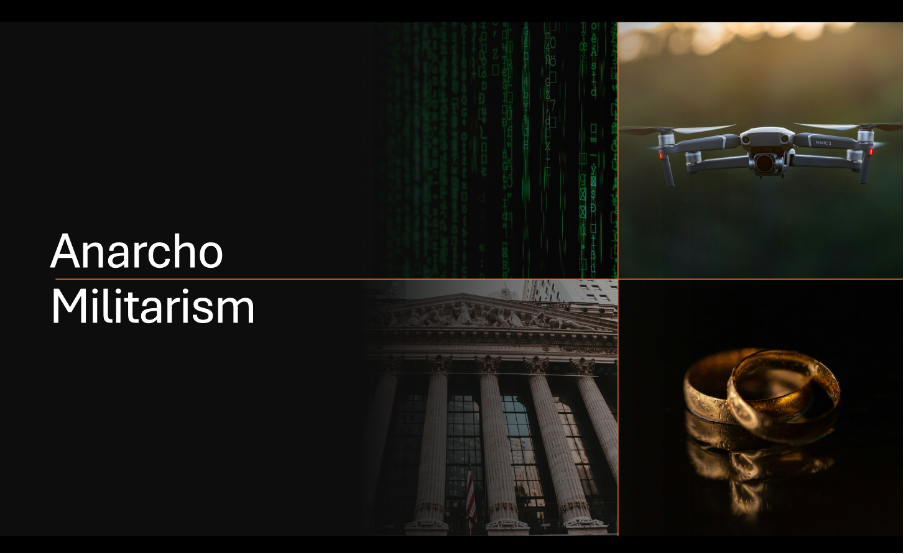
These are not members of the traditional Military-Industrial Complex (MIC), but rather the emerging Military-Technology Complex (MTC) — what one might call the algorithmic barons.
Their rise coincides with a precarious chapter in the history of the United States — one in which the authority of institutions is being directly challenged, notably by President Trump.
Power Without Mandate: When Private Capital Writes Foreign Policy
Congress appears to lack not only the spine but the stamina to challenge the executive — not merely as a matter of political contest, but in defence of what remains of the United States’ post-Second World War perceived credibility.
In this vacuum, the direction of travel is troubling: the very guardrails that once upheld the so-called international “rules-based” order are now being dismantled from within. What was once a framework for global legitimacy risks becoming a self-inflicted casualty of unchecked power.
The erosion of global goodwill and trust in the United States has become blatant, shedding any pretense of subtlety. The era of restraint is over. Washington now openly—and with little concern—undermines the very foundations of the “Rules-Based International Order” it once championed.
That demolition is well underway. This structure is no longer merely fragile — it is, like America’s ballooning sovereign debt, structurally bankrupt. And, much like its Treasury, it struggles to recapitalise its reserves — whether in legitimacy, leadership or leverage.
We are in the midst of what I call “tech-enabled, outsourced, off-balance-sheet regime changes”— a model where private capital is gaining unprecedented mileage in shaping foreign policy. What was once covert and government-driven is fast becoming an overt, public–private posture for intervention. It’s a taxing exercise for the global majority, and a high-maintenance asset for the enablers behind these operations
As the United States continues to engage in extraterritorial, extrajudicial, and extralegal actions, the rest of the world is left to decipher how these trends will ultimately converge — and what form the emerging order will take.
The ascent of companies like Anduril, Palantir, and the financial entities born of their ecosystem — such as Erebor Bank, which has ambitions to replace the now-liquidated Silicon Valley Bank (SVB) — represents a significant undercurrent. These are not peripheral developments. They are the early signals of a shift that geopolitical strategists, CEOs and foreign policy professionals should be interrogating with rigour and depth.
All of this is unfolding at a time when the coffers of the United States government are showing unmistakable signs of fiscal fatigue. Partisan paralysis has brought about yet another government shutdown — one in which servicemen and women, along with their families, are forced to rely on food stamps, and emergency pantries. ( Source : WHAS11 News — Watch on YouTube ). Meanwhile, Washington contemplates the logistics of yet another regime change operation abroad, this time in Venezuela.
